Today energy efficiency is no longer just a buzzword. For large sports facilities, shopping centres, industrial enterprises, and retail chains, effective energy consumption management is directly tied not only to operational costs but also to brand reputation. The lower the energy costs and carbon footprint, the more competitive a company becomes and the greater the trust of its partners.
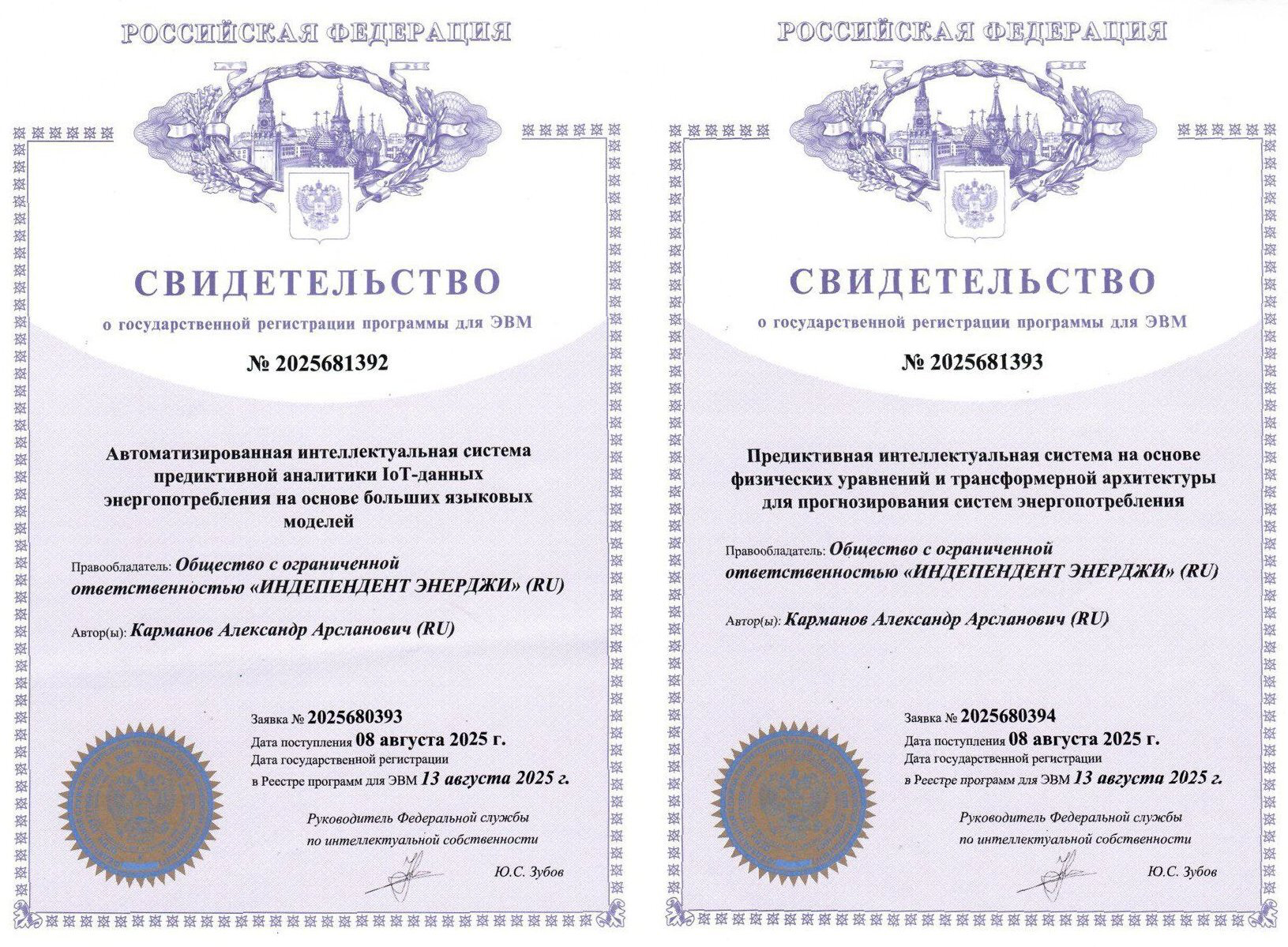
Independent Energy has been operating at the intersection of engineering, digital technology, and sustainability for several years. Our projects demonstrate that the right combination of sensors, analytics, and automated control can reduce site energy consumption by 20–30% without sacrificing service quality. But we are going further. Recently, we developed a predictive energy analytics programme based on large language models (LLMs). This development confirms that we not only implement advanced solutions but also create our own world-class technologies.
What the Patent Covers
The patented software is designed for automated forecasting and analysis of data from IoT sensors. It uses intelligent algorithms based on LLMs to transform raw data into meaningful predictions and actionable recommendations.
Its applications are broad, ranging from intelligent energy management systems to automated building monitoring for sports arenas and industrial facilities. Essentially, it acts as the “brain” that helps manage a site so it uses less energy while operating more reliably.
Key Capabilities Include:
This means the system does not merely record data — it can anticipate what will happen in minutes or hours and advise on what actions to take.
Why LLMs Matter for Ecomanagement
Large language models are widely known for text generation, but their potential in engineering systems is far greater. LLMs can handle heterogeneous datasets, detect patterns, and explain complex outcomes in simple language. In our solution, LLMs serve several functions. They help engineers to:
For example, instead of interpreting a complex graph to determine a required setpoint, an operator might receive a message like: “Load has changed; the current return glycol temperature setpoint is -9°C.” This reduces time spent on routine manual tasks and minimises the risk of human error.
How It Works in Practice
Take the example of an ice arena. Ice temperature is highly sensitive to thermal loads: during ice laying or public skating sessions the surface temperature can change rapidly. If the refrigeration machines aren’t adjusted promptly, the ice quality degrades and energy consumption rises.
We developed a forecasting model for ice temperature based on a transformer architecture, with physical heat-balance equations built into its loss function. This allows the model to account for site inertia and align predicted temperature with delivered power and external conditions. Testing has shown this model to be significantly more accurate in transitional regimes than traditional architectures such as LSTM, GRU, or plain Transformer models, and particularly robust during sudden temperature shifts.
Adding our new patented LLM-based module further enhances this model: it automatically analyses sensor data, verifies forecasts, and generates clear recommendations — for example, when to activate cooling, how much power to reduce, or how to redistribute load. In this way, a complex physics-informed model becomes a practical tool for operators.
Economic and Environmental Impact
Why does this matter for business? Firstly, it delivers cost savings. A 20–30% reduction in energy consumption for an arena or shopping centre can mean hundreds of thousands of roubles saved each month. Secondly, it improves reliability — fewer breakdowns, fewer unscheduled repairs, and less peak stress on equipment. Thirdly, it benefits the environment: every unit of energy saved means fewer CO₂ emissions. At a large facility this can equate to hundreds of tonnes annually.
Our patent encapsulates our ability to combine machine learning, physics, and LLMs into a single system that delivers tangible results — from reducing bills to improving ESG reporting.
Beyond Sports Facilities
While the ice arena example is illustrative, the technology is not limited to sports. In retail, we use it to manage refrigerated displays and air-conditioning systems. In industrial complexes, it optimises ventilation and heating. In office buildings, it integrates with BMS to create comfortable conditions for occupants. Everywhere the principle is the same: data is collected automatically, forecasts are physics-aware, LLMs analyse and explain, and the control system makes optimal decisions.
The Future of Ecomanagement
We are confident that the future of engineering systems lies in predictive control. Digital twins of buildings will forecast energy consumption before conditions change. Artificial intelligence will autonomously adjust equipment operation based on weather and load. And large language models will act as an interface between the system and humans — explaining results, advising users, and helping guide decisions.
The software developed by Independent Energy is a significant step on this path. It solidifies our position as a company that does not just follow trends but shapes them. We create technologies that make buildings smarter, reduce business expenses, and shrink environmental impact.
Conclusion
Next-generation ecomanagement is not just about sensors and dashboards — it is the synthesis of physics, artificial intelligence, and large language models. This approach allows engineering systems not only to register current conditions but also to predict the future and optimise proactively.
Independent Energy has proven this approach in practice and secured it with a patent. We are proud to build technologies that deliver real value to clients, help save resources, enhance asset reliability, and support sustainable business growth. Our software is not the end point but a launchpad for further research and implementation. We see our mission as building systems that will become the standard for ecomanagement in Russia and beyond — and we are confident that the future of smart buildings begins today, with Independent Energy.
Independent Energy has been operating at the intersection of engineering, digital technology, and sustainability for several years. Our projects demonstrate that the right combination of sensors, analytics, and automated control can reduce site energy consumption by 20–30% without sacrificing service quality. But we are going further. Recently, we developed a predictive energy analytics programme based on large language models (LLMs). This development confirms that we not only implement advanced solutions but also create our own world-class technologies.
What the Patent Covers
The patented software is designed for automated forecasting and analysis of data from IoT sensors. It uses intelligent algorithms based on LLMs to transform raw data into meaningful predictions and actionable recommendations.
Its applications are broad, ranging from intelligent energy management systems to automated building monitoring for sports arenas and industrial facilities. Essentially, it acts as the “brain” that helps manage a site so it uses less energy while operating more reliably.
Key Capabilities Include:
- Automated collection and preprocessing of IoT sensor data
- Intelligent analysis of energy consumption time series
- Automated model selection and optimisation for forecasting
- Visualisation and interpretation of forecast results
- Generation of equipment management recommendations
This means the system does not merely record data — it can anticipate what will happen in minutes or hours and advise on what actions to take.
Why LLMs Matter for Ecomanagement
Large language models are widely known for text generation, but their potential in engineering systems is far greater. LLMs can handle heterogeneous datasets, detect patterns, and explain complex outcomes in simple language. In our solution, LLMs serve several functions. They help engineers to:
- Process large volumes of data more rapidly
- Automatically select tailored models for specific sites
- Interpret forecasts in a way that’s understandable to both technical specialists and decision-makers
For example, instead of interpreting a complex graph to determine a required setpoint, an operator might receive a message like: “Load has changed; the current return glycol temperature setpoint is -9°C.” This reduces time spent on routine manual tasks and minimises the risk of human error.
How It Works in Practice
Take the example of an ice arena. Ice temperature is highly sensitive to thermal loads: during ice laying or public skating sessions the surface temperature can change rapidly. If the refrigeration machines aren’t adjusted promptly, the ice quality degrades and energy consumption rises.
We developed a forecasting model for ice temperature based on a transformer architecture, with physical heat-balance equations built into its loss function. This allows the model to account for site inertia and align predicted temperature with delivered power and external conditions. Testing has shown this model to be significantly more accurate in transitional regimes than traditional architectures such as LSTM, GRU, or plain Transformer models, and particularly robust during sudden temperature shifts.
Adding our new patented LLM-based module further enhances this model: it automatically analyses sensor data, verifies forecasts, and generates clear recommendations — for example, when to activate cooling, how much power to reduce, or how to redistribute load. In this way, a complex physics-informed model becomes a practical tool for operators.
Economic and Environmental Impact
Why does this matter for business? Firstly, it delivers cost savings. A 20–30% reduction in energy consumption for an arena or shopping centre can mean hundreds of thousands of roubles saved each month. Secondly, it improves reliability — fewer breakdowns, fewer unscheduled repairs, and less peak stress on equipment. Thirdly, it benefits the environment: every unit of energy saved means fewer CO₂ emissions. At a large facility this can equate to hundreds of tonnes annually.
Our patent encapsulates our ability to combine machine learning, physics, and LLMs into a single system that delivers tangible results — from reducing bills to improving ESG reporting.
Beyond Sports Facilities
While the ice arena example is illustrative, the technology is not limited to sports. In retail, we use it to manage refrigerated displays and air-conditioning systems. In industrial complexes, it optimises ventilation and heating. In office buildings, it integrates with BMS to create comfortable conditions for occupants. Everywhere the principle is the same: data is collected automatically, forecasts are physics-aware, LLMs analyse and explain, and the control system makes optimal decisions.
The Future of Ecomanagement
We are confident that the future of engineering systems lies in predictive control. Digital twins of buildings will forecast energy consumption before conditions change. Artificial intelligence will autonomously adjust equipment operation based on weather and load. And large language models will act as an interface between the system and humans — explaining results, advising users, and helping guide decisions.
The software developed by Independent Energy is a significant step on this path. It solidifies our position as a company that does not just follow trends but shapes them. We create technologies that make buildings smarter, reduce business expenses, and shrink environmental impact.
Conclusion
Next-generation ecomanagement is not just about sensors and dashboards — it is the synthesis of physics, artificial intelligence, and large language models. This approach allows engineering systems not only to register current conditions but also to predict the future and optimise proactively.
Independent Energy has proven this approach in practice and secured it with a patent. We are proud to build technologies that deliver real value to clients, help save resources, enhance asset reliability, and support sustainable business growth. Our software is not the end point but a launchpad for further research and implementation. We see our mission as building systems that will become the standard for ecomanagement in Russia and beyond — and we are confident that the future of smart buildings begins today, with Independent Energy.