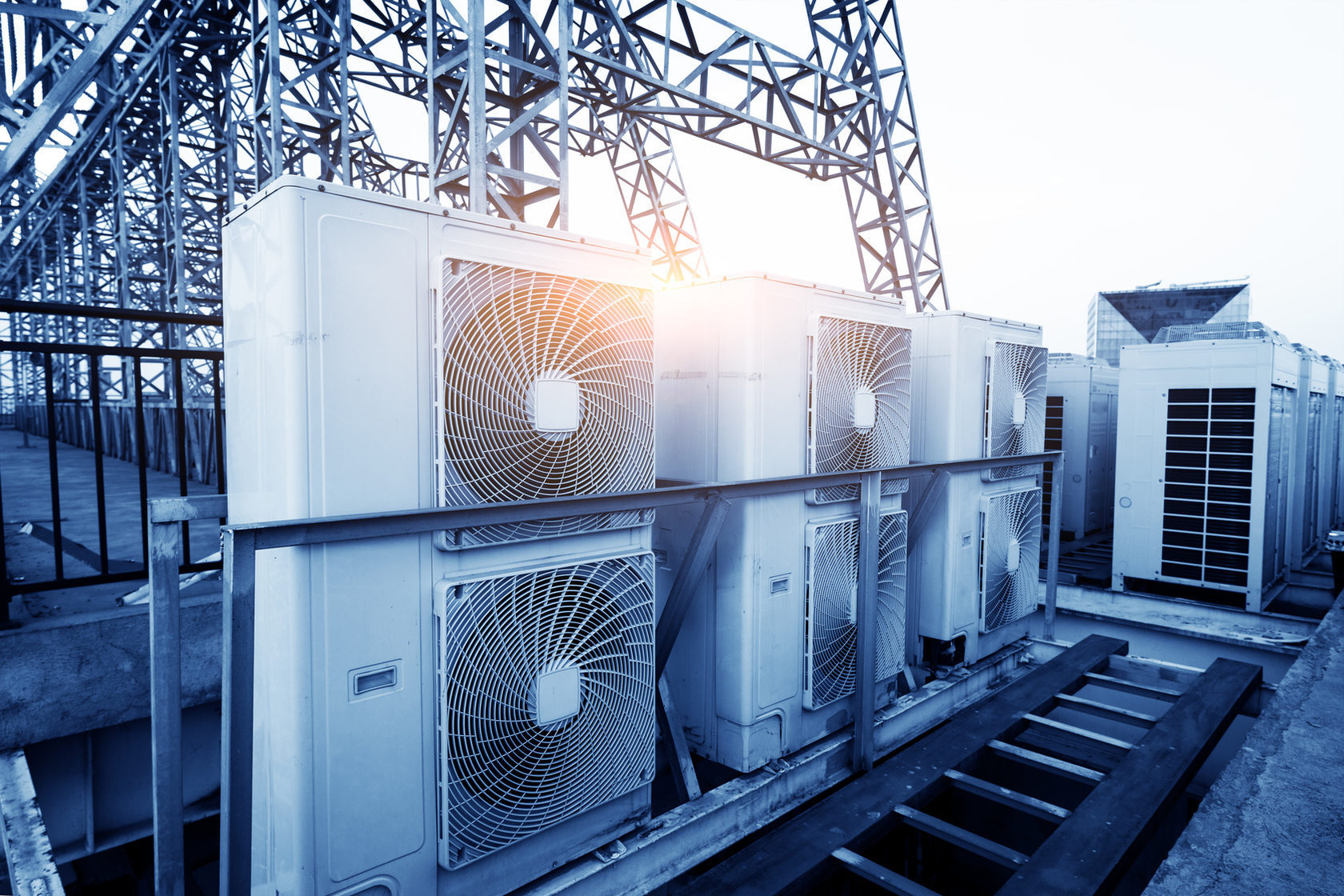
Last week Schneider Electric, one of the world leaders in building automation, published a study titled "AI for Climate: Quantifying the Energy and Carbon Impact of Building Optimization." The headline is impressive: add an AI-powered "smart" layer on top of a building management system, and an office will use roughly 22% less energy.
The results were obtained through building energy modeling: the authors took a typical office of about 5,000 m² in Brisbane, Miami and Mumbai and validated the model against real-world pilot deployments. The full study is available on the Schneider Electric website.
We are glad to see the industry's biggest players arriving at the same numbers we do. Schneider Electric's study validates the potential of the technology; at Ecomanagement, that effect is already measured in our clients' monthly utility bills. Our platform runs on real sites in more than 50 regions of Russia, from Arkhangelsk to Vladivostok.
Not a Model — Real Bills
Every month we sit down with each client and reconcile how much energy was saved. Savings are calculated under the international IPMVP protocol and Russian standard GOST R 56743-2015, and the report is signed off by the client. Here is what that looks like in practice:
• a 4,000 m² grocery supermarket uses 23% less electricity — about 34,700 kWh every month;
• ice arenas save up to 35% of their energy, while ice and climate stay strictly within spec;
• in a business center of about 18,000 m², first results appeared within a week of launch: ventilation under platform control now uses 66% less energy, and ventilation and air conditioning combined use 31% less — with only half of the ventilation systems connected so far;
• a national fitness chain has connected more than 120 clubs to the platform, and the first of them paid back the investment in 11 months on average.
The Schneider Electric study compares two approaches: running a building from the cloud or from on-site hardware. We don't choose — we use both. The on-site controller makes decisions on its own and keeps working even if the internet goes down. The cloud gathers data from every building so our engineers can see the big picture and catch problems early. The platform manages heating, ventilation, air conditioning, refrigeration, lighting and water, and is built on domestically produced hardware.
What Lies Ahead for Tariffs
In September, the Ministry of Economic Development updated its forecast for 2027–2029. In spring the ministry expected noticeably calmer growth; now the numbers are almost twice as high:
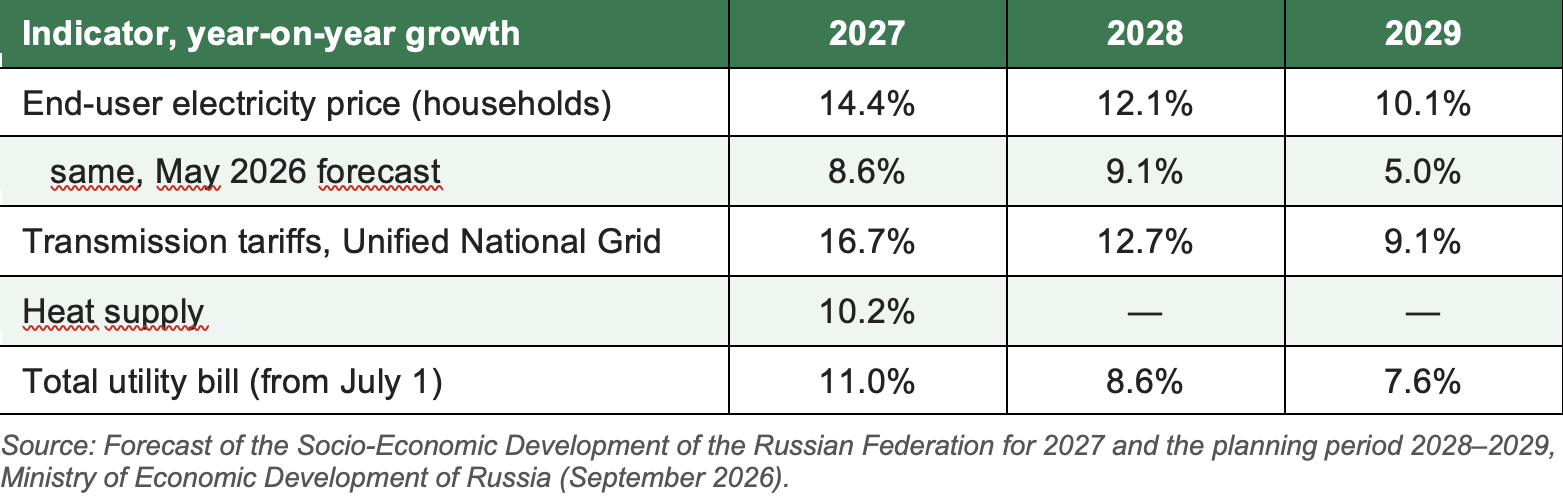
Added up over three years, the household electricity price will rise by about 41%. Businesses should watch the grid component of the tariff: transmission over the backbone grid will become 16.7% more expensive in 2027 alone. Heat and water will also go up, with an additional 1.5% a year built into tariffs to modernize utility infrastructure. And the next increase is just around the corner — October 1, 2026.
The Cost of Waiting
The ministry does not publish a separate price forecast for businesses, so the following example is illustrative. If the bills of a café or shop paying RUB 300,000 a month for electricity today grew at the same pace as household prices, by 2029 it would pay about RUB 424,000 at the same consumption — an extra RUB 1.5 million a year. Actual dynamics for a given site depend on the region and pricing category, but the direction is the same: up, and noticeably faster than inflation.
Cut consumption by 20–25%, and most of that increase simply never happens. But there is a catch: the system has to be running before tariffs go up. It needs time to "learn" the building, and savings start adding up from the very first month. That is exactly why rising tariffs are fueling interest in automation: those who start early meet every increase with smaller bills already in hand. Those who wait for the new invoices end up fighting fires.
The Language Finance Understands
When a chief engineer defends an investment program, the conversation usually comes down to one question: "What will it earn us?" Facility management teams still don't always evaluate projects the way the finance department does — through payback period and internal rate of return (IRR). That is a missed opportunity, because those are exactly the numbers that decide whether a project gets funded.
Ecomanagement solutions pay back in 11 months on average. With a payback that fast, IRR over a three-year contract is exceptionally high — well over 100% a year. But even on sites with a modest payback of 2–2.5 years, IRR over a five-year operating horizon is at least 35–40%. For comparison: even at the historical peak in December 2024, the average maximum deposit rate at Russia's largest banks was about 22% a year. Today, even loyal customers with every privilege are offered less than 12% by the largest banks — for example, 11.75% on a six-month deposit. In other words, money invested in smart building automation works 1.6–1.8 times harder than a deposit at its best-ever moment for savers, and more than three times harder than a deposit today.
Five years is not an arbitrary figure. Ecomanagement sustains savings over the entire service life of the equipment — and that is the key difference from a conventional building management system (BMS). A BMS is tuned once at commissioning, and then the familiar story unfolds: tenants and operating schedules change, equipment wears, facility staff switch units to manual mode "to stop the complaints" — and within a year or two, little of the savings is left. Our platform checks actual consumption against the baseline every day, the algorithms adapt to changes in the building, and engineers at our monitoring center see immediately when something goes wrong. That is what makes the product so valuable over the long run: savings hold as long as the service runs, and if you drop it, they quickly fade away.
For the chief engineer's team, that is a very strong argument. Add Ecomanagement's financial guarantee with a clearly fixed payback period, and the investment case becomes very hard to dispute: the client's risk is clear and capped, and the return beats any conservative alternative.
Deposit rates: average maximum rate of the ten largest banks per the Bank of Russia — 22.08% (first ten days of December 2024); current rate — 11.75% per annum on a six-month deposit at the country's largest bank, including loyalty privileges (September 2026).
Not Just for Business Centers
Interestingly, Schneider Electric's study reaches the same conclusion we did: small buildings benefit the most. In the past, such systems were too expensive and too complex for them, and they rarely have an in-house facilities engineer. Today, that is no longer a problem:
• Fast. We equip a 250–400 m² café in 3–4 nights — during the day it operates as usual.
• No in-house engineer needed. Our monitoring center watches the equipment around the clock.
• No large upfront investment. Pay by subscription, or lease the solution with a down payment from 10% and a term of up to five years.
"It's gratifying to see global leaders arrive in their calculations at the same numbers our clients see in their reports every month. But what matters to a business is seeing results at its own site — and today that is already possible. Tariffs for the next three years are already known, and they are growing faster than inflation. Just a few years ago, smart building management was only available to large business centers. Today the technology has become so simple and affordable that it pays off almost anywhere — even in a bakery or a kiosk. The time to prepare for rising tariffs is now, not when the new bills arrive," — Grigory Kazakov, co-founder and CEO of Independent Energy LLC.
About Ecomanagement
Ecomanagement is a platform for autonomous management of building engineering infrastructure and energy: HVAC, power supply, refrigeration, lighting and water. It combines on-site controllers with cloud analytics. The platform is developed and owned by Independent Energy LLC, a Skolkovo resident company. The technology is protected by Russian Patent No. 2821067 and five registered software certificates. Ecomanagement solutions operate in more than 50 regions of Russia across fitness clubs, retail, food service, fuel stations, ice arenas, and warehouse and industrial facilities.
Media contacts
info@ecomanagement.pro | +7 (495) 741-93-30 | www.ecomanagement.com